chitika2

الثلاثاء، 27 يناير 2015

العثور على دبلومات دراسية مفقودة ببوسكورة. ( يرجى النشر )

العثور على دبلومات دراسية مفقودة ببوسكورة. ( يرجى النشر )
*المعني بالأمر: نورالدين تريرت NOURDDINE TOURIRT
من مواليد 07/08/1984 بحي سيدي احساين بناصر بورزازات
*الوثائق المفقودة: شهادة الباكلوريا، الإجازة وشهادة النجاح في الإجازة 
*مكان العثور على الوثائق: دوار الحوامي (لكليتة) بوسكورة / الدارالبيضاء
يرجى من كل من يعرف هذا الشاب الإتصال بالأرقام أسفله التي تخص الشخص الذي عثر على هذه الوثائق جزاه الله خيرا.
يرجى نشر هذا الإعلان على أوسع نطاق والله لا يضيع أجر من أحسن عملا.
الهاتف 0633955294 أو 0669793760


الخميس، 22 يناير 2015

Le nom ou substantif

Le nom (appelé aussi substantif) est un mot variable en nombre, qui a en lui un genre (masculin ou féminin).Il est le plus souvent accompagné d'un déterminant et il peut avoir de nombreuses fonctions dans la phrase :

sujetL'enfant joue.
objetJ'observais l'enfant.
attributCe n'est encore qu'un enfant.
appositionFrançoise, tout enfant, aimait déjà le chant.
complément circonstancielJe voyagerai avec l'enfant.
complément d'un autre termeLes parents de l'enfant sont là ; ils sont fiers de leur enfant.
Les noms qui désignent des êtres vivants (et plus spécialement des êtres humains) sont souvent variables en genre.un instituteur, une institutrice – un partenaire, une partenaire.

Noms communs et noms propres

Un nom commun est un nom que l'on utilise pour nommer tous les éléments d'un même ensemble. Le nom commun a une définition. Lenom propre, lui, ne sert à nommer qu'un seul élément (un lieu, une personne…) et il n'a pas de définition.Les noms propres s'écrivent avec une majuscule. Contrairement aux noms communs, ils s'emploient dans de nombreux cas sansdéterminant.Catherine est arrivée (le nom propre Catherine s'emploie sans déterminant).La secrétaire est arrivée (la est le déterminant, article, qui accompagne le nom secrétaire).

Noms animés et noms inanimés

Un nom animé désigne un être humain, un animal, une divinité… par opposition au nom inanimé qui désigne un objet, une qualité, une action…
Certains termes, par exemple, ne s'emploient qu'avec des noms animés, d'autres qu'avec des noms inanimés : ainsi l'adjectifimminent ne qualifie que des noms inanimés, jamais des personnes.Une réponse imminente (mais pas un imminent spécialiste).

Noms comptables et noms non comptables

Un nom comptable est un nom qui désigne quelque chose qui peut être dénombré, compté, par opposition aux non-comptables.nuage, feuille, fourchette : sont des noms comptables (deux nuages, trois feuilles, cinq fourchettes).blé, lait, sable, pluie : sont des noms non comptables.Ainsi, on peut dire J'ai vu deux nuages, mais on ne dira pas J'ai vu deux pluies.
Selon leur sens ou leur emploi, certains noms peuvent être non comptables ou comptables.Veau est un nom comptable quand il désigne l'animal (les veaux sont dans l'étable) et un non-comptable quand il désigne la viande ou le cuir (Achète un kilo de veau chez le boucher).On emploie parfois dénombrable pour comptable et indénombrable pour non-comptable.

Noms collectifs

Un nom collectif est un nom qui, tout en s'employant au singulier, désigne un ensemble composé de plusieurs éléments.foule, dizaine, chênaie, bétail, clientèle…
Il peut se poser des problèmes d'accord quand un nom collectif est accompagné d'un complément désignant les éléments qui le composent.Une foule de touristes envahit la place (ou envahissent).

french picture


الأحد، 23 نوفمبر 2014

Lesson 23 - Introduction to Rapid STP (802.1w)

Lesson 23 - Introduction to Rapid STP (802.1w)

Good news is that if you have learned 802.1d protocol (STP standard), only few things change in terms of the terminology and operation in the Rapid Spanning-Tree Protocol. RSTP is clearly an evolution of the regular STP but definitely NOT the revolution. The three phases of operation mentioned in lesson 20 still apply. 

This post is going to be the last in the series on Spanning-Tree Protocol fundamentals.

Let's focus on the major changes introduced in RSTP by comparing it to the standard STP.
  • STP Port States: "disabled", "blocking", "listening" are renamed to DISCARDING inRSTP. As far as the "forwarding" state, the name remains unchanged.
  • STP Port Roles: designated and root roles are still the same. But the non-designated role has been split in two new ones: ALTERNATE and BACKUP roles in RSTP.
Below picture will give you an indication as to what they describe.
Pic. 1 - Rapid STP Alternate Port.

Icons designed by: Andrzej Szoblik - http://www.newo.pl

An alternate port is a port that is in a blocking state and receives superior (better) BPDU frames from another switch. The port F0/2 of SW2 is the example of alternate port.
Pic. 2 - Rapid STP Backup Port.
Icons designed by: Andrzej Szoblik - http://www.newo.pl
A backup port is a port in the blocking state that receives superior BPDU frames from the same switch like shown in Pic. 2. The port F0/3 of SW3 is the example of backup port.

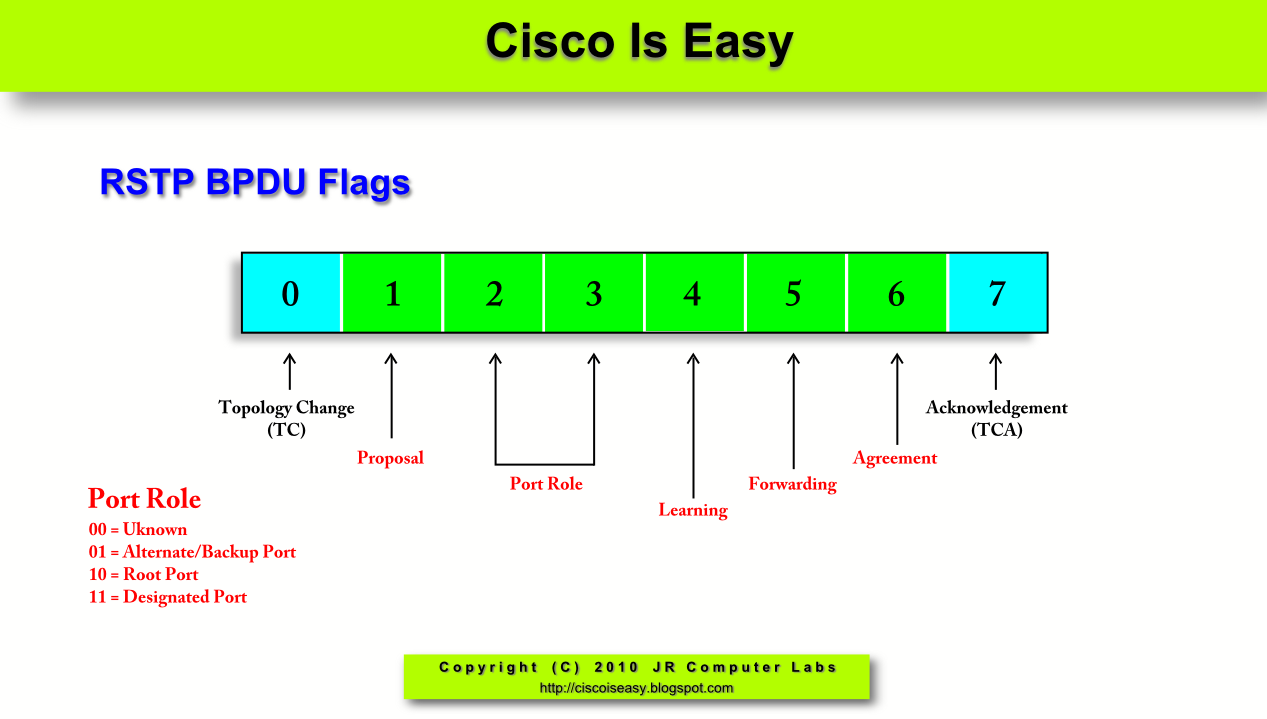
Cisco STP Enhancement such as: spanning-tree uplinkfast and spanning-tree backbonefast are no longer used (except for spanning-tree portfast which Cisco still maintain in the IOS as an edge port). They have been replaced with negotiations of the port state that is based on the previously unused flags in the BPDU frame and a different mechanism of sending BPDU frames. The flags are shown below (pic. 3).

Pic. 3 - BPDU Flags.

Understanding the nuts and bolts of the RSTP operation is beyond the scope of this tutorial. All you need to know at this stage is the terminology and benefits of using it over a legacy STP. The major advantage of RSTP is that switches use BPDU frames differently than before. Ports, upon first connection or when topology changes, exchange BPDUs with proposal/agreement flags set helping achieve fast transition to the appropriate state. They negotiate whether the port should be the designated, non-designated or root port role. If the port becomes the root port, all other ports begin negotiation by exchanging proposal/agreement BPDUs since the path towards the root bridge is different. It is extremely fast mechanism that speeds up the convergence upon a topology change.

A few other changes implemented in RSTP you must be aware of are as follows.
  • All switches exchange BPDUs instead of relaying them after they have received them from the root bridge. BPDUs have become a true keepalive mechanism. The switches do not have to wait for the root bridge to notify them about topology change that occurred somewhere in the network. A switch that detects change notifies its neighbors about it. And those in turn, notify their neighbors immediately. It is a mechanism similar to OSPF updates in that respect.
  • RSTP is backward compatible with STP (802.1d) speaking switches. Upon receiving BPDU version 1 (802.1d), the port transitions to the legacy STP protocol. All timers (max_age, forward_delay) are used according to the STP specifications (802.1d).
There are also two new concepts introduced in RSTP that are worth mentioning:
  1. Edge Port - which is something you are already familiar with. It is the port that is the candidate for a quick transition to forwarding state as it connects device that cannot create the loop (no BPDUs received on that port). Cisco enables Edge Port capability by using spanning-tree portfast feature described in the previous lesson. The ports must be a point-to-point link type (full duplex).
  2. Link Type - the type of the link is derived from the duplex of the port:
  • Full Duplex = Point-to-Point link
  • Half Duplex = Shared link
All these changes serve one purpose: they help in fast convergence on a detection of the new connection or/and a topology change. The speed of convergence is similar to the one when Cisco STP Enhancements are used in STP. The difference is that now fast convergence is accomplished as an industry standard mechanism, not a proprietary solution.

The configuration of RSTP is pretty straightforward.
SW(config)#spanning-tree mode rapid-pvst

That is it!

Deterministic election of the root bridge and all the jazz related to it explained in the previous lesson are identical.

If you want to learn more on RSTP operation google it by using this query:
understanding rstp. You'll find a plethora of documents out there.